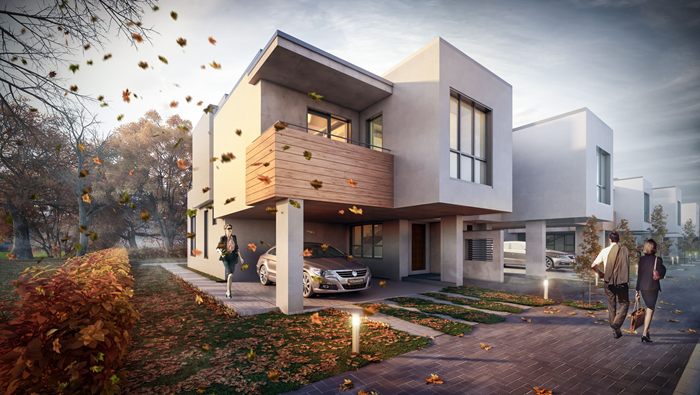
A 3D visualization of a house is a digital model of the future property that shows the architecture, materials, lighting, and surroundings before work begins on site.
It transforms drawings and specifications into a clear picture, allowing the client, architect, and contractor to more quickly reach a common understanding of the final result.


In construction, 3D rendering project for a European developer helps identify errors early, clarify estimates, and reduce rework. Instead of disputed interpretations of plans, a visual guide appears, supporting problem-solving at all stages—from concept to finishing.
Why 3D visualization is needed at the design stage
During the design stage, visualization allows for the evaluation of the building’s proportions, site layout, and exterior appearance in various variations. This is especially important when approval is required from the client’s family, investors, or authorities reviewing architectural solutions.
- Verifying the architectural concept: you can compare several facades, roofs, and window groups and select the optimal option.
- Early detection of inconsistencies: conflicts between the architecture and the structure are noticeable (e.g., opening heights, stairways, and abutments).
- Refining materials: textures, colors, and finish combinations are easier to assess visually than from descriptions.
- Communication with the contractor: fewer questions about «how it should look» and more attention to the execution technology.
A tool for approvals and customer confidence
When the customer sees the house in its entirety, the risk of subjective disappointment is reduced: expectations are formed based on a specific image. Visualization helps to agree on contentious issues—basement height, terrace size, canopy shape, window rhythm—before changes become expensive.
Linking the dimensions of the cottage to the site: checking the fit, setbacks, and orientation to the cardinal directions
3D visualization during the project-to-site linking stage allows you to see in advance how the cottage fits within the boundaries, including passageways, driveways, and landscaping areas, and avoid mistakes that lead to rework and lost time during construction.
A model with the exact dimensions of the house, the terrain, and key features of the site allows you to verify compliance with standard setbacks, the correct heights, and ease of use, as well as assess the orientation to the cardinal directions based on real-world conditions.
What is checked in 3D before construction begins?
- Plot boundaries: the dimensions of the house and terraces/porches correspond to the actual building footprint, and the correct alignment to corners and boundary lines.
- Setbacks and restricted areas: distances to boundaries, roads, neighboring buildings, and utility corridors; Ensuring that protruding elements (canopies, bay windows, balconies) do not violate requirements.
- Orientation to the cardinal points: location of main rooms and glazing, analysis of insolation, overheating in summer and lack of light in winter, sun protection planning.
- Driveway and turnaround: entry paths, parking location, driveway width, ease of access to the entrance and utility areas.
- Topography and elevations: need for backfill/excavation, plinth height, porch and terrace placement, slopes for water drainage.
- Viewpoints and privacy: viewing directions from windows and from the terrace, screening from neighbors, placement of recreation areas.
Result: linking the dimensions of the cottage to the site in 3D turns the «flat» plan into a verifiable model: you can see where the house really is The layout is correct, whether offsets are respected, how solar orientation works, and how access roads and terrain are organized. This reduces the risk of approvals and rework, helps make accurate decisions before going to the construction site, and speeds up the transition to working drawings and construction.